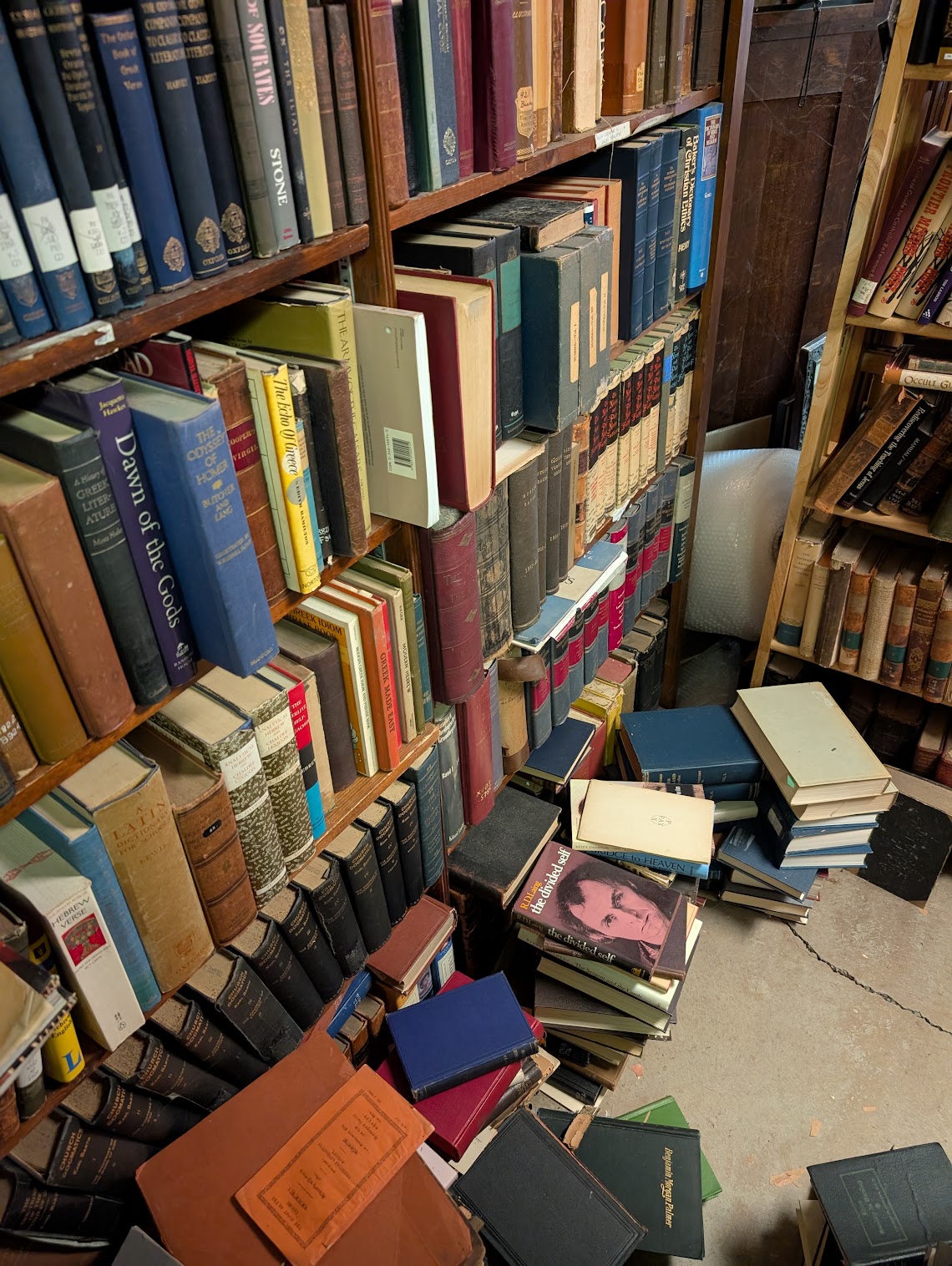
As a college student, I formed the habit of buying old books. They were everywhere in Boston in the 1970s. A few years later, the streets of New York teemed with old books, laid on the steps of a brownstone, on a blanket on the sidewalk, or discarded in cardboard boxes at the curb. There were stores for remainders and overstock, as befitted the capital of publishing. The Strand Book Store, on Broadway at East 12th Street near Union Square, recalled an era when second-hand books were thick on Fourth Avenue. The Strand survives as a cultural landmark, a temple of the cult.
When I left New York in the 1980s, I settled in Charlottesville, Virginia, a university town. Forty years later, Charlottesville has half a dozen shops that cater to my need. I pick tattered volumes from trays displayed on sawhorses at waist height, crooked shelves in a badly lighted shop, a rummage sale for a worthy cause, piles in a junk store, the dim basement of a church, and a wobbly card table on the dew-soaked grass of a neighbor’s front yard on Saturday morning.
I enjoy the hunt, the play of chance, the good price, the unrecognized gem. I find standard textbooks, former best-sellers, titles once again in the news, and guides to subjects I never heard of and suddenly must learn all about. I do not search for rare books, first editions, or leather bindings stamped and gilded. My quest is for content.
Yet a good cover catches my eye. A paperback copy of A Sportsman’s Notebook by Ivan Turgenev, published by Viking in 1957, has a drawing of a riverbank with rowboats, peasants in smocks, thatched log houses, and a bulbous church beyond. I am fond of little books in boards and cloth, trigesimo-secundo titles that fit in a pocket, like Old Kensington Palace and Other Papers by Austin Dobson, printed by Oxford University Press in 1926. I like fold-out maps, battlefield diagrams, photos of busts, drawings of coins, and engravings of ruins, as in A History of Greece by J. B. Bury, from Macmillan in 1909.
A used bookstore on Main Street, in what was formerly a jeweler’s shop, calls itself Read It Again Sam. Dave Taylor, the owner, resembles Humphrey Bogart as Rick Blaine in the movie Casablanca. Cranky, with a previous life that includes military service and fine carpentry, Dave has a passion for discipline. His shelves are in order, clean, and clearly labeled. He scolds blithe customers who drop trash and talk too loud on their mobile devices. Mute, I wander and stare at the spines of books. I find a book that sparkled once in another setting. I slide it out, examine its facets, and weigh it in my palm. Priced at a few dollars, is it a gem?
Rereading is a pleasure of retirement. The theater and concert hall recede, along with crowds and hoopla. Solitude and books come to the fore. Edgar Allan Poe died a premature death at the age of forty, but he sensed this shift. He embeds a poem in his short story “Ligeia” about a learned lady, dearly beloved and long ago deceased, “certain verses composed by herself.”
Lo! ‘tis a gala night
Within the lonesome latter years!
Literature needs the flesh of experience to make its full effect. Insights and turns of phrase that lodged in my brain, like grains of sand in an oyster, now shine like pearls. Despite what you hear, taste improves with age.
*
While packing for a move, which occurs at intervals of five to seven years, out of restlessness or what seems at the moment to be a good investment, I purge my shelves and cull my book collection. I find books I don’t recognize, titles that stir no memory. I sample a page, read a whole chapter, and forget the task at hand. I revise opinions and reverse judgments. I air a mind as dusty as the books. I discard a few, later regret a hasty decision, and find them again for sale cheap.
When my architectural practice ended, I got rid of books on architecture. Some were reference books, material specifications, product catalogs, zoning ordinances, and engineering manuals, publications that go out of date. Some were historical, on a period or an architect. And some were lavishly illustrated studies of houses and cities. These gave me many hours of pleasure. Would I ever open their covers again? They struck me as professional nostalgia. I held on to the red bulk of Sir Banister Fletcher’s A History of Architecture and books on cities – Paris, Rome, London, and Boston.
I gave away drafting equipment and a plotter for drawings, heavy electronics. And I threw out rolls and rolls of paper, old drawings of projects completed long ago. Some of my buildings have been demolished. Others still give satisfaction as I pass them in the car. I felt a little sad about ending a career, and a little relieved.
I stayed put in a cottage that suits my status, and I moved on in spirit. No doubt I will acquire and shed more books, as passions flare and fade, like feathers that change with the seasons. And when I depart, some reader of used books will be glad.
*
At the used book sale in the basement of the public library, I elbow through the crowded maze with an armful of books. Others are up to their chins. We are flushed and happy. So many great titles, old and new! Not discards from the library’s collection, but donations from residents, university professors, freelance reviewers, casual browsers, and affluent consumers who barely cracked the spine.
Parking is in short supply, so I walked from home in the brisk air, to the Gordon Avenue Branch in Charlottesville, Virginia. Many public libraries hold an annual sale. This one happens in April and October. They use the proceeds to fund operations, buy new books, and host events.
Nine times out of ten, we book buyers are the same as the donors. As population subsets, we are indistinct, like varieties of finches that interbreed. Charles Darwin could not classify us as separate species. In our plumage of coats and hats and scarves, as we browse and peck at the rows of books, we are all Friends of the Library.
Some fly to the extreme of membership, which is open to anyone. Some are volunteers. By virtue of their expertise in English Literature, Art, Physics, Military History, Cooking, Gardens, Religion, and Parapsychology, they sort through hundreds of boxes of books and haul them to storage. The sale goes on for ten days, during which the volunteers haul the boxes to empty spots in the warren of shelves and fill them with books. Shoppers come back again and again. Some of us bring our own boxes, sturdy bags, and backpacks. Conversations spring up, and old friends reconnect. This semi-annual social event, like a migratory flock, is not to be missed.
Owners of used book stores, dealers in rare books, and trade professionals scout the sale. I spot them by their sense of purpose, the way they evaluate a book not solely for literary merit, but as merchandise: condition, date, publisher, and price. Scott Fennessey is one who frequents the basement aisles. His smart attire, silver hair, and snow-white whiskers, perfectly groomed, identify him at a glance. With eagle eye he scans the shelves. With talon fingers he plucks a title. His judgment is swift. He flings the book in a box at his feet, or he thrusts it back. He favors me with a nod but will not pause to chat. Too much is at stake.
The manager of the sale is in no hurry. Relaxed and rumpled, with gray hair gathered in a ponytail, and a salt-and-pepper beard, Peter Manno is a genial owl. He glides through the cramped space with ease, answers questions in a low murmur, and directs his staff of volunteers with a flick of the wrist. This complex operation is a lark, he implies. What could be more fun than heaving heavy boxes and finding shelf space for thousands of books?
They are priced at a fraction of what they cost when new. Paperbacks are a dollar. A new hardcover in perfect condition costs two or three. What a bargain! On sober reflection, when will we ever read them?
I stagger to a table near the door. A checker totals my pickings in pencil on a slip of paper. I present this slip to a lady at a table topped by a metal strongbox and a credit card machine. She accepts all forms of payment except for crypto-currency, which is too bad given the underground venue.
I stumble outside. The air is brisk and the sun is bright. I breathe and blink. The way a small propeller plane distributes luggage and passengers, I adjust my cargo and set a course for home.
*
Busy people say they have no time to read. Can this be true? What keeps them so busy? They follow the news, comment on politics, serve on committees, fulfill professional obligations, keep house, raise children, answer the phone, and check email. They substitute activity for life.
These dynamos freely confess. They brag about how busy they are, how much in demand. They are victims of overwork. Some have retired from a full-time job and are now deep into a second career, a long-delayed artistic pursuit, or a service gig. The habit of staying busy dies hard. With so much to read for work, for school, for the next board meeting, how could they relax with a book?
I lounge and read for hours. Yet I lack the patience to watch a story unfold on television, or sit through a tedious exposition in a movie theater full of strangers, or peer at tiny figures on a screen no bigger than the palm of a hand. There is nothing immediate about these media. Virtual reality is a jail for volunteers, a portable prison, like wearing a bulky blindfold.
Solitary, I flee confinement. I love the freedom of reading text, unbound by videotape. The printed word is faster. When the going gets slow, I skip a paragraph. I read the last page to see how it ends. I stop and reread a sentence. I savor it, and time stands still. If I miss some vital bit of information, a character’s name, what day it is, where we are, or how this dolt acquired a fortune, I turn back or start over from the beginning.
Books and magazines are what I prefer, but more and more, I read onscreen, articles and stories that simulate ink on paper. New technology lets the printed word travel farther and faster, and I am all for it. I scroll up and down the endless page. Impulsively, I click on links to photographs, maps, footnotes, sound clips, and related articles. I waste time. Like Alice in Wonderland, I fall down the rabbit hole of interesting topics. I used to track down meanings, synonyms, roots, and etymologies in a dictionary. Like an endless forest, the internet beats that hollow.
Samuel Johnson confessed to James Bowell that he seldom read a book straight through. He skimmed, flew from page to page, and extracted the essence as a bee sucks nectar. This was his method late in life, when his eyesight was poor. As a student at Oxford, he was diligent, he said:
In my early years I read very hard. It is a sad reflection, but a true one, that I knew almost as much at eighteen as I do now. My judgement, to be sure, was not so good; but I had all the facts.
I am less sure of myself than the great essayist and dictionary compiler. Yet fifty years ago as a college student, I had a flash in the reference room of Widener Library, a grand concourse of printed facts. The way a sinner sees the light, I believed in that moment I had learned enough to research any topic.
Johnson’s confession makes me feel better about my reading habits. I flit from book to book in the course of a day, and within one volume can hardly stay on a single page. Dogged readers say when they start a novel they must finish or feel guilty. Without a pang, I abandon the story and return when I am ready. The writer forgives my absence and welcomes me with a smile. She knew I would come back.