My career as a girl began with my own sex rejecting me. I was the new second grader at Christian Academy in Japan, and a piggish American girl named Chelsea, with chocolate perpetually smeared across her facial regions, singled me out almost immediately. Chelsea had an authoritarian quality and the bodily confidence of somebody who had already been there awhile, and from the minute she saw me she hated my guts, and then all the other girls followed suit. I spent recess alone at the far edge of the playground, sitting on a tree stump, jotting down ruthless observations in my notebook. Occasionally, a boy would come over to see what I was up to. Early on I took this to mean I probably wasn’t a real girl. That feeling never went away.
By third grade there was a Swedish girl named Josie whose parents let her carry a briefcase to school.
A BRIEFCASE.
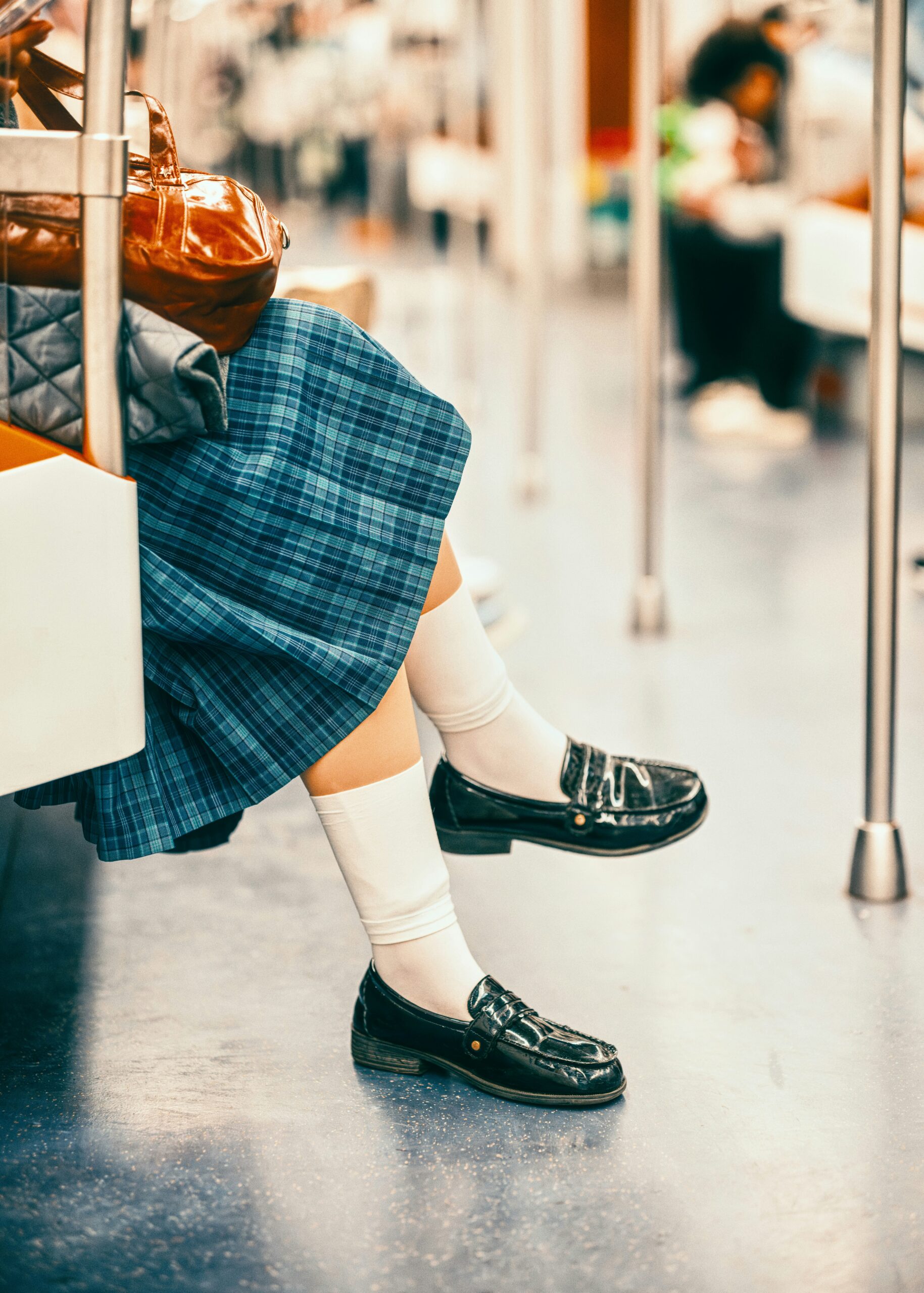
She had translucent white skin and reddish-blonde hair and wore smocked dresses or sometimes this miniature businesswoman getup copied from her mother, starched white shirts, flarey grey skirt, leather loafers polished to a supernatural shine, and whenever she came into a room the Japanese moms would ooh and ahh over her as though Sweden had sent over a royal specimen. She walked around with her nose turned up so high she’d step on my toes. I thought she looked plain dumb. I mean, seriously – a briefcase?
Boys meanwhile were easy. Boys would punch you, throw something at you, call you a freak, then five minutes later have amnesia and ask if you wanted to go look at a dead thing behind the gym. There was movement in it. Girls had icy stares. Girls had costumes. Girls could keep a grievance alive through three lunch periods and a weekend. I never understood why they were so complicated, and I learned to hate them back.
Part of the problem was that I looked like a boy. My mother dressed my brother and me nearly identically, same boys’ underwear, same jackets, same bowl cut duplicated over two heads, and it never occurred to her that this efficiency might be a social problem. My brother was basically my second bodily appendage, and many mistook us for twins except that I liked Micro Machines more. If one child required pants, buy two pants. The only girl clothes I possessed came out of missionary donation boxes shipped over by churches in Texas, gigantic cardboard reliquaries of other people’s castoffs, and the crown jewel was a velvet dress two sizes too big with a sash ribbon at the waist, a gold crinkly panel running diagonally across the bottom, enormous black dots and puffy shoulder tumors which I understood to signify femininity. Somebody in America had thrown it away. I was told to wear the thing like I was on a runway in Paris, so I saved it for special occasions.
Karen Aoki and Linnea Eby were the two girls every girl modeled herself after, and both were daughters of teachers at school. Karen was half Japanese and half white and played the flute beautifully and all the teachers constantly fussed over her unassailable normalness. Linnea was perfect, and I still have the photographic proof of her sitting with the dainty pink ribbon in her perfect hair and perfect cornet upright next to me, and I, looking like an electrocuted poodle with no eyes, because that year my mom thought it would be fun to perm my bangs. Their clothes fit their bodies. Already this seemed advanced.
One day I asked Karen.
“What’s your secret?”
“What?”
“Your clothes.”
“What about them?”
“How do you know what goes together?”
She looked down at herself like I had asked how she operated her elbows.
“You just match the colors.”
“What colors?”
“Like your turtleneck and sweater.”
“And pants?”
“Yes.”
“Same color?”
“Not the same. Matching. Like blue and white. Purple and yellow.”
This was enormous information.
I went home and commenced matching.
Soon one of the Chinese aunties looked me over.
“Ann! You look so good today? Did you pick your own clothes?”
“Yes.”
“Where did you learn this?”
“My classmate Karen.”
She nodded.
“Not your mother.”
“No.”
“Mm,” she said, like she already knew.
Still, I could not crack the hair things. Braiding. Barrettes especially. I could buy a barrette. I could possess one. I could insert it into my hair. Twenty minutes later it had migrated halfway down my skull or was dangling from three hairs above my ear.
Karen’s did not move.
There were clips too. Sparkly things with teeth.
I never got to the bottom of any of it.
Nor, really, the whole female civilization.
Then there was Anna Kojimoto. By fourth grade, she was prim and prissy and liked soft-boiled eggs. One afternoon in the corridor we had an argument about God knows what, something enormously important for approximately eleven minutes, and it turned into a proper girl fight, meaning clawing got involved. I was wearing the velvet dress. I had put it on that morning on purpose, and there I was in the hallway with my hands buried in Anna Kojimoto’s hair and hers buried in mine, and at some point Anna got hold of the sash and yanked it clean off. Somebody separated us. The sash was recovered but never reattached. From then on the dress had a sort of wounded veteran quality.
My birthday came a few weeks later and I decided to behave maturely. I made invitations by hand. I wrote each name carefully. I gave one to every girl in the class including Anna Kojimoto, which I regarded as an act of almost Christlike diplomacy considering the sash incident.
Nobody answered.
Not one.
No yes, no no, no mother calling my mother, no folded piece of paper coming back. Nothing. I waited in the elaborate way children wait, which is not passive at all but involves surveillance. Check desk. Check bag. Look at Anna without looking at Anna. Walk slowly past somebody at recess in case they are about to mention Saturday. Keep face approximately normal. Inspect cubbyhole again.
Nuthin’.
So I invited the boys instead. Not all of them, only the ones I liked, plus the one I had a crush on. The boys came. We had a birthday party. We ate at my favorite Chinese restaurant. The chicken tasted very good. Then we had a snowball fight.
I soon realized that the girl situation had deteriorated past anything I could reasonably manage alone. It required a more formal organization.
I thus started the
I HATE GIRLS CLUB
A charter was drawn up, mostly of prohibitions. One unifying vision.
Be thick-skinned.
NO CRYING
No lip gloss.
No heart-shaped notes.
NO BARBIES
No sitting with a girl who had scraped her knee and wanted the knee attended to.
Recruitment commenced and was frankly not difficult. Boys will join virtually anything if you give them an office. I only took pliable, nice boys. Jared, Joel, Ryan, Billy, Ian, and maybe one more whose name I have lost. I was President, obviously. Jared became Vice-President. I cannot remember if we had dues. We should have had dues.
One day, I sent a memo out.
MISSION 1: Unleash the maximum amount of torture upon the girls permitted by the school timetable.
The task was bookmarks. We removed the bookmark from every book any girl in the class was reading. All of them. This took most of one morning and involved a certain amount of reconnaissance because you had to know who was reading what and when the desk would be vacant. By lunch the operation was complete and approximately half the female population had lost its place.
Yeeaaaaa.
We were thrilled. I even manufactured Boy Scout-type badges with bookmarks on them and distributed decorations accordingly.
Task two involved written propaganda.
I HATE YOU
BROWN NOSER
FATTY
MEANIE
We deposited these in desks. We cleverly did not sign them.
Task three was less formal and involved general intimidation. Half-breathed insults. Pigtail interference. Standing closer to somebody than the social situation required. Any member who completed an action was expected to report directly to me.
JARED: I switched all the girls’ shoes around in the shoe cupboard.
ME: Good work.
I patted him on the back and he walked off anointed. Boys will do a tremendous amount for a pat on the back. Girls will do virtually nothing for one. That is the entire difference between them, and I figured that out all by my lonesome.
Task four happened during P.E. We were learning tinikling, which I understood at the time to be Japanese because everything around me was Japanese.
Tinikling is from the Philippines.
Two children crouch at opposite ends of two bamboo poles and beat them against the floor and then together, floor, floor, clap, floor, floor, clap, while another child dances in and out between them. If the dancer has rhythm everything works. If the dancer does not have rhythm the poles close around the ankles.
I preferred operating the poles. The floor position had strategic advantages. Nobody looks at the pole people. Everybody looks at the dancer.
So I began shutting the poles slightly early.
Not on everybody.
Selection was involved.
A girl would hop in.
CLACK.
Ankles.
Down.
Another girl.
CLACK.
Down.
Several acquired abrasions. One or two walked off and whimpered. It looked exactly like what it looks like when a child is not very good at tinikling. I remained seated on the floor at my end of the poles, keeping the beat, seraphic.
Hundred bucks it was Linnea Eby who tattled. A hand clamped around my upper arm.
MRS. CHAPMAN: PUT A STOP TO THIS RIGHT NOW, ANN LEE.
ME: What are you talking about.
MRS. CHAPMAN: I know about your club.
ME: There’s no club.
MRS. CHAPMAN: I know you’re the one leaving these.
She had one of our communications between two fingers and she held it approximately six inches from my eyeballs.
BROWN NOSER
ME: That’s not mine.
MRS. CHAPMAN: Ann.
ME: It’s not.
MRS. CHAPMAN: Ann Sung-an Lee.
ME: It’s not my handwriting.
She turned the paper around and looked at it herself, slowly, the way you look at a thing you have already looked at.
MRS. CHAPMAN: I have twenty-six children in that room. I know all your handwriting.
I said nothing.
MRS. CHAPMAN: You do the b’s like that. Nobody else does the b’s like that.
She indicated the b.
I looked at the b.
There it was.
My b had a loop.
Unfortunately, I had used this same loop extensively. I had put it on every one of the birthday invitations, sitting at home making each one carefully, one for every girl in the class, including Anna Kojimoto, then carried the whole hopeful packet to school in my bag and distributed them one by one over the course of a week.
Not one had come back.
MRS. CHAPMAN: Do you understand me.
ME: Yes.
She released my arm. Nobody had stopped. The girls had the poles now, and they kept perfect time.
Floor, floor, clap. Floor, floor, clap.